Quick version
- A 2024 pilot study looked at PEMF and sole depth in just 10 horses (6 had PEMF, 4 didn't).
- The PEMF horses showed a trend toward deeper soles in one area of the right front foot (P=0.07).
- A trend isn't a proven result. The usual bar for "significant" is P=0.05 or lower.
- Palmar angle and the other sole depth measurement didn't change.
- It's a reason for bigger studies, not a treatment for thin soles. Your vet and farrier lead on hoof care.
What Did the PEMF Sole Depth Study Look At?
Ten adult horses of mixed breeds: six had PEMF, and four were a control group that had no treatment. The researchers wanted to know whether PEMF changes sole depth, which matters a lot for hoof health and comfort.
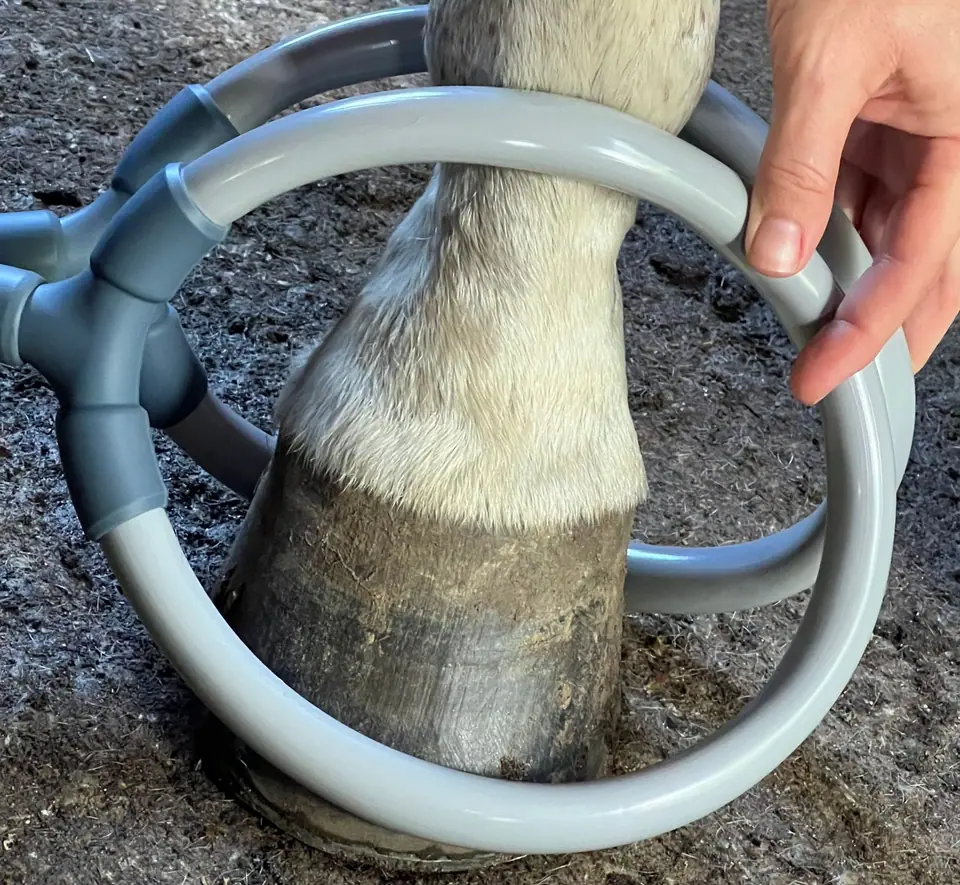
The setting: 22 Hz, applied directly to both front hooves.
The schedule: 10 minutes, three times a week (Monday, Wednesday and Friday) for 30 days.
The measurements: X-rays the day before the first session and again 30 days later, measuring sole depth and palmar angle.
What Did the Study Find?
A trend toward increased sole depth beneath the distal processes of the right front foot in the PEMF horses (P=0.07). That was the only measurement that moved:
- Sole depth, one area of one foot: a trend toward deeper soles in the PEMF group. Not statistically significant.
- Sole depth, the other measurement: no change in either hoof (P=0.65).
- Palmar angle: no change (P=0.24).
So what's a P value? Roughly, it tells you how likely a result is to be down to chance. Scientists usually want P=0.05 or lower before they call something significant. The study's authors noted anything up to 0.1 as a trend, which is exactly what it sounds like: a hint worth following up, not a finding you can rely on.
What Does This Mean for My Horse?
Not much yet, and I want to be honest about that. Ten horses is a very small study, the result was a trend rather than a significant finding, and it showed up in one area of one foot. The researchers themselves say further research is justified, and I agree.
What I like about it is that someone is finally measuring PEMF and the hoof on X-rays instead of guessing. If bigger studies back it up, PEMF could one day be a useful, non-invasive support for horses who struggle with thin soles. I'll be watching for them.
Where Can I Read the Full Study?
It's free to read online. Here's the full reference:
Matz MM, Alexander DL, Moore J, Fedorka CE. Evaluating the effect of pulsed electromagnetic field (PEMF) therapy on sole depth of the equine hoof: A pilot study. Journal of Equine Rehabilitation. 2024;2:100010.
Read the study (doi.org/10.1016/j.eqre.2024.100010) (opens in a new tab)
New to PEMF? Read: What does PEMF do for horses?

Wondering whether PEMF suits your horse?
PEMF can be booked on its own or with massage. Send me a message with your questions, or book a session and we'll talk it through at the barn.