Quick version
- Only stretch warm muscles: right after a warm-up, groundwork or a ride. Never before.
- Carrot stretches: 3 sets of each position, holding 3 to 5 seconds. Use a long bait you can cup in your hand.
- Limb stretches: guide, don't pull. Stop at the first resistance and hold there.
- Make sure your horse is standing square on soft, non-slip ground, not concrete.
- Sighs, soft eyes, licking and chewing = good. Snatching the leg back, holding their breath or pinned ears = back off.
Why Should You Stretch Your Horse?
Not just for flexibility. Done correctly, every stretch tells you a lot about how your horse is really feeling. I see static stretching as a conversation, and every stretch asks your horse a question:
- Are they yielding smoothly, or guarding the joint?
- Are they relaxed, or trying to yank their leg back?
- Is the stretch better or worse than last time?
The answers show you tightness, left-right differences and compensation habits. For a competition horse, that's a quick check on which side needs attention after a busy show weekend.
Carrot stretches (dynamic mobility exercises) do something extra. To hold a position while reaching for the bait, your horse has to switch on their core, the thoracic sling, to stay balanced. So they may help with core strength as well as range of motion through the neck and back.
Should You Stretch Your Horse Before or After Riding?
After your horse is warm. Stretch straight after a warm-up, groundwork or your ride, never on cold muscles. Then run through these four checks:
Warm up first.
Straight after a warm-up, groundwork or your ride. A cold muscle is more likely to tear. My own horse gets lunged or at least 15 minutes of easy work first.
Pick your footing.
Soft, level, non-slip ground. Never concrete.
Square them up.
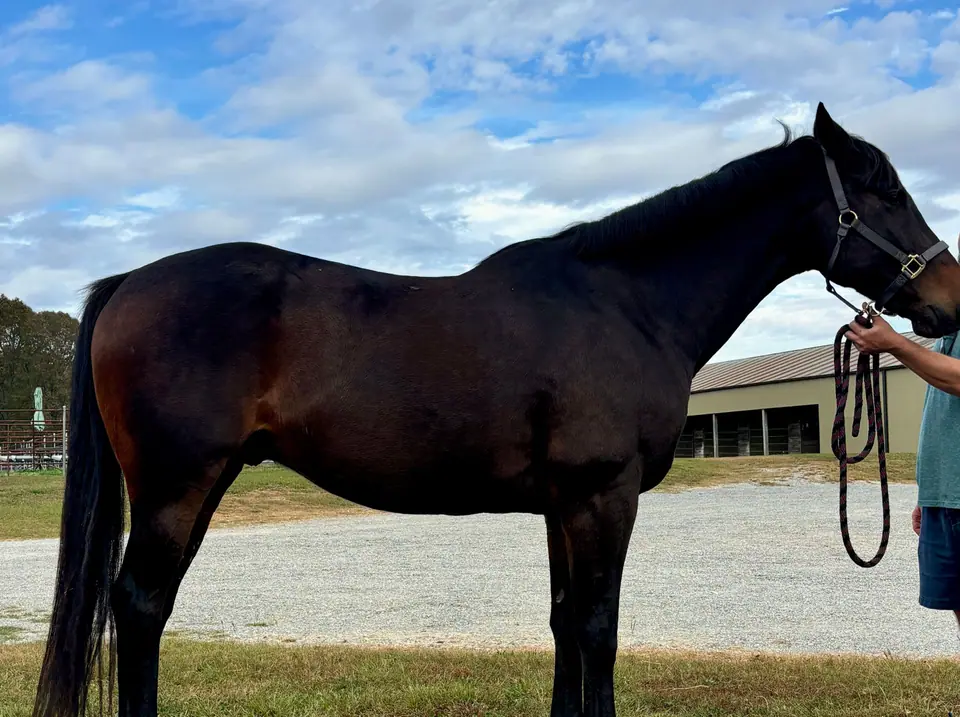
Your horse should be standing square on all four feet before you ask for anything.
Stand to the side.
Never directly in front of your horse or underneath their head.
Part 1: Carrot stretches, step by step
These are the six positions I focus on with my clients:
- Chin-to-chest
- Chin-to-knees
- Chin-to-fetlock
- Neck extension (out and up)
- Nose-to-girth (each side)
- Nose-to-hip (each side)
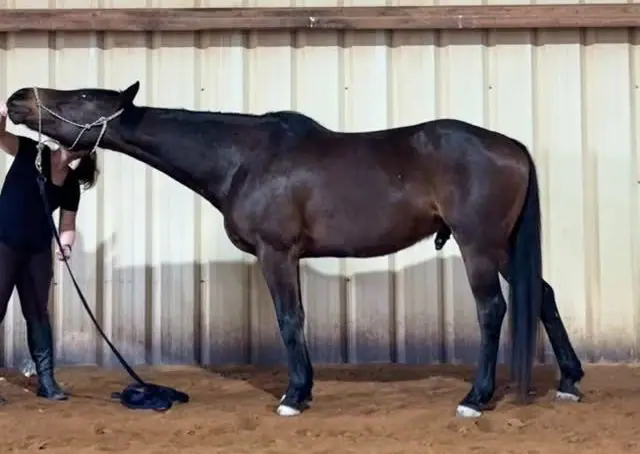
How to hold the bait. The tip I get asked about most! Use a long bait you can cup in your hand: wrap your fingers around your thumb and tuck the bait between your thumb and knuckles. Your horse has to nibble at it, so they hold the stretch longer.
How many and how long. Aim for 3 sets of each position, holding each one for 3 to 5 seconds. On a busy day I'll pick 3 or 4 positions and rotate through those, always listening to my horse.
Reset when they cheat. If your horse tilts their head to reach the bait the easy way, or steps out of square, stop, reset and ask again. A smaller, straight stretch is worth more than a big crooked one.
Part 2: How Do You Stretch a Horse's Legs?
Gently guide and support the joints, and never push or pull your horse's leg. I shift my own weight back (or lean slightly) and let the leg come with me.
Front limb mobility stretch (forelimb forward)
Good for horses with short strides or tight shoulders.
Lift the front leg gently. Place one hand behind the knee and one behind the fetlock.
Slowly and gently bring the leg forward until you feel restriction or resistance. Keep the leg low and never pull or force.
Hold for 3 to 5 seconds, then set the foot down softly.
Forelimb retraction (leg back)
The same idea in reverse. It lengthens the muscles that pull the leg forward, like the brachiocephalicus and trapezius.
Hind leg forward: high vs low
Height matters. Forward and high mostly lengthens the hamstrings (important for jumpers). Forward and low also reaches the tensor fasciae latae, which supports the stifle.
Lateral neck stretch
When your horse bends left, the muscles on the right are the ones lengthening. So if they struggle to bend left, it's the right side that needs to release. (This is where most people get confused!)
Front limb in and out (abduction and adduction)
Great for horses doing lateral work, who often have tight chest muscles. Keep it a very small movement, never far past the midline.
How long to hold
At the first resistance, stop guiding and hold: 3 to 5 seconds to start, working up to 5 to 10. If your horse pulls the leg away, let them. Try again, but never force it.
Stretching should never be a wrestling match
Force a limb past what your horse's nervous system feels safe with, and their reflex is to brace. Bracing defeats the whole purpose.
Signs of a good stretch
- A deep sigh or exhale
- Softening around the eyes and ears
- Gently leaning into the stretch
- Licking, chewing or yawning after the release
Watch for (back off if you see these)
- Snatching or pulling the limb back
- Holding their breath, pinning ears or turning away
- Shifting weight or stepping sideways to get out of it
What Are the Most Common Horse Stretching Mistakes?
These are the four I see most:
- Stretching cold muscles.
- Not checking that your horse is standing square.
- Forcing the stretch past their natural limit.
- Letting your horse tilt their head to cheat.
Well-meant stretching really can injure a horse, so save this for your next barn day.

Want me to take a look?
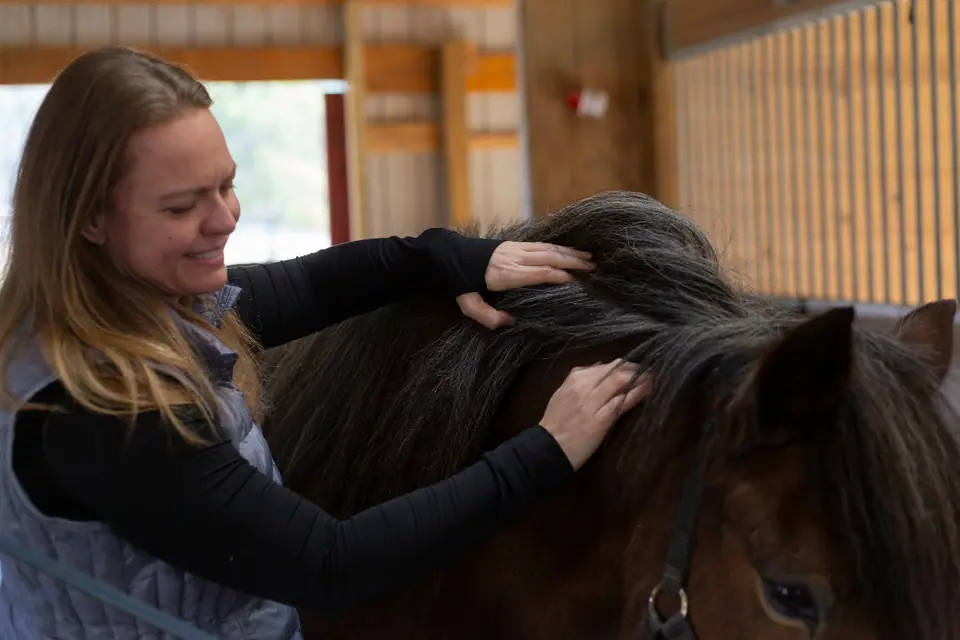
Every session ends with a detailed session report and individualized homework for your horse, including which stretches to do and how far to take them. I'd love to show you in person.
Bodywork supports your horse's wellbeing alongside veterinary care. It is not a substitute for it. If your horse is lame, unwell or recovering from injury, please check with your vet first.
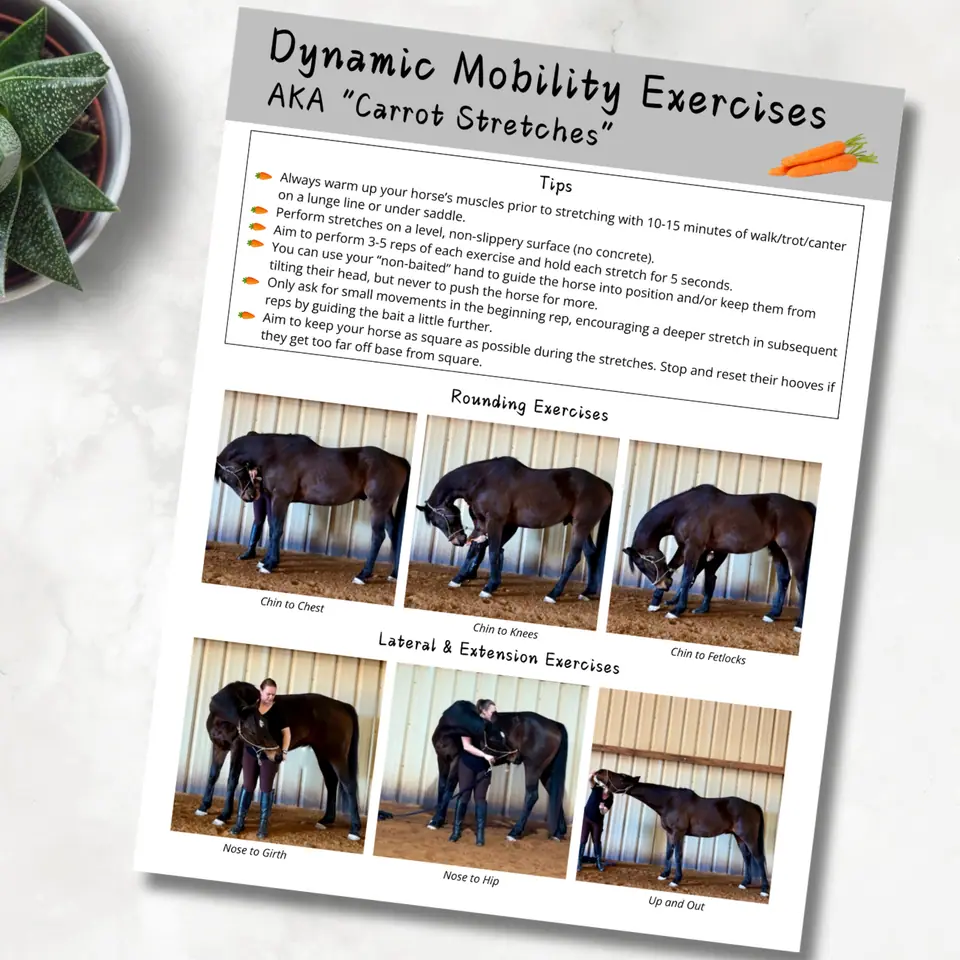
Free printable
The Carrot Stretch Card
A free one-page PDF: the six carrot stretch positions, the "how to hold the bait" grip, 3 sets of 3 to 5 seconds, and the safety lines, ready to pin up at the barn. Free download confirmed. Jen is redoing it with new images
- The six carrot stretch positions
- The "how to hold the bait" grip
- 3 sets × 3 to 5 seconds
- The 4 before-you-start checks: warm, footing, square, stand to the side
- Good-stretch vs back-off signs
- The four safety lines